Home

Case studies

Real-world examples of AI productivity work. Each one sets out the brief, the diagnostic, the call and what the client did next. Where a study mentions Level 101 to 401, that's the 4-stage AI adoption framework I use, from first experiments at 101 to technical implementation at 401.

01 · blu-fish

The office, not the engineers.

Mark, Director, blu-fish

Challenge

The business ran mostly on manual systems: paper job tracking, invoices assembled by hand, a spreadsheet for gas safety renewals, and an office team absorbing the same details typed in at every stage of a job. Mark wanted to grow towards 20 staff and assumed what held him back was engineering capacity.

On the Diagnostic call I asked him one thing: if 200 new landlord properties arrived tomorrow, what breaks first? His answer was immediate. "Not the engineers. The admin."

Solution

The report named 5 processes worth changing, with invoicing and closing off jobs at the top. It also picked up that a member of his team had spent 18 months building an internal job management system, so the recommendations were written to work alongside it.

So the install was built as a teaching day, not a software drop, with the goal of leaving him able to carry on alone. He wrote the business brief himself, about 1,100 words in his own voice, and Matthew Thistle structured it with the AIMED framework (Act, Instruction, Method, End-goal, Distil) so Claude would read it the way he meant it. His email, files and calendar were connected, under one rule: nothing reaches a customer unless he's read it first.

Results

  • 1 day onsite. 11 weeks later he was building his own business tools, with no further paid help.
  • 4 to 6 hours of office admin per large testing job, now targeted by a tablet platform he built himself.
  • A new quoting tool in about 30 hours of his own time: survey, price and send the quote before leaving the site.
  • His conclusion: the field team can grow without adding office staff.

"we could expand our field team by quite a few members without needing additional headcount in the office because we're just going to be able to create more capacity."
Mark, Director, blu-fish
Read the full story

02 · Skincare

When the blocker is a decision nobody has made

The brief

A leading UK skincare brand commissioned a 2-stream AI diagnostic.

What the diagnostic found

In marketing, it found the main blocker wasn't skill or appetite but a deferred decision on policy and access: paid AI tools sat with the 2 most senior people, while the heaviest repetitive work, up to 10 hours a week of image resizing, sat with people on free tools.

What the business did next

Within 3 months the business issued an AI use policy, offered Claude licences to all staff and began testing image production as its first automation pilot.

03 · Wealth management

When the firm is already building it, quietly and correctly

Challenge

The practice operates inside a tightly regulated environment: closed-model toolset only, national-network compliance sign-off on all client-facing output, and a mandated upload of documentation to the national customer relationship management (CRM) system. Within those constraints, the Principal had built something quietly unusual. The paraplanning team was running 7 operational agents on the approved closed-model stack, handling PDF extraction, letter-of-authority chase, annual review preparation and adviser-voice email drafting. A compliance pre-check agent was 4 weeks from go-live.

The Principal sat at Level 201 with emerging 301. The paraplanners at 201. The adviser cohort at 101, by deliberate sequencing, not drift. It was well-governed AI adoption. What it didn't yet have was a named plan for what comes next.

Solution

Matthew Thistle delivered a diagnostic: a 60-minute in-person session scoped entirely inside the national network's compliance envelope.

The session covered:

  • 10 targeted questions about workflows, team structure, approved toolset and build pipeline
  • Analysis against the 4-tier AI adoption framework (101 to 401), mapped cohort by cohort
  • Inventory of the existing agent stack: live, in build and still manual
  • Blocker diagnosis across skills, permission and workflow categories

Results

The report surfaced an atypical profile. Where most small and medium-sized firms present with a dominant skills gap, this practice didn't. The skills position was partial by design. The binding constraints were permission-shaped and workflow-shaped, both already managed rather than unresolved.

The diagnostic identified 2 high-value opportunities. First, a 6-week adviser adoption pathway covering 3 defined use cases only: meeting debrief, client-voice email and post-meeting action capture. This comes before paraplanner-led throughput makes the adviser layer the next capacity ceiling. Depth over breadth.

Second, protective instrumentation for the compliance pre-check agent before go-live: a lightweight rework-request log to baseline the 4-week build window, and a trace-rendering agent that auto-generates an external-facing document from the pre-check agent's own operation. The log proves the value; the trace answers the question the regulator or network might eventually ask.

"I think we are a long way ahead. I know what our peers do, and they are not using anything."

Principal, during the diagnostic

Most AI diagnostics tell a firm what to buy.

This one told a firm what it had already built, and what it needed to do next to protect it.

The 301 insight

The most consequential finding wasn't a recommendation to adopt new tooling. It was naming what the practice had already built, and sequencing the finish. Most firms at this stage are told what to deploy. This one needed the opposite: a structured account of what it had done correctly, and a protective plan for the single build that mattered most.

Diagnostic highlights

Service type
A diagnostic (60 minutes, in person)
Participants
Principal and Investment Adviser, representing a 10-person team
Primary challenges
Strong existing AI adoption with no named plan for adviser-cohort transition; single highest-value agent build approaching go-live without protective instrumentation; regulated environment constraining tool choice and documentation flow.
Key findings
Principal at Level 201 with emerging 301; paraplanning team at 201; adviser cohort at 101 by deliberate sequencing; 10-item AI stack inventory (7 live, 3 in build); atypical blocker profile with skills partial and compliance dominant.
Outcome
A 10-page diagnostic report, with 2 prioritised opportunities, a 90-day sequence and 4 follow-on engagement options presented to the Principal.

04 · Fintech

When leadership gets it but the team isn't there yet

Challenge

A construction fintech startup had built an elegant product: a biometrically verified, ring-fenced payment platform for high-value construction supply chains. The leadership team was already using AI tools with real sophistication. They had a working compliance FAQ built in NotebookLM. Their core payment workflows used structured exception handling that reflected advanced architectural thinking. They weren't afraid of AI. They were hungry for it.

But the operational team hadn't been brought along. The gap between what leadership understood and what the wider team could specify, build or maintain was the company's most consequential bottleneck. And with only 1 live customer project and Financial Conduct Authority (FCA) regulation on the horizon, the window to get the whole team aligned was narrowing.

Solution

Matthew Thistle delivered a strategic diagnostic session covering the full scope of the company's operations, AI maturity, data protection posture and growth trajectory.

The session covered:

  • 10 targeted questions about current workflows, team structure and operational constraints
  • Analysis against the 4-tier AI adoption framework (101 to 401)
  • Assessment of data protection alignment for a regulated financial services environment
  • Identification of the first viable agentic deployment opportunity

The diagnostic revealed something unusual. Unlike most businesses that sit at a single adoption level, this company operated across several levels at once. Leadership was at Level 201 with emerging 301 capability. Operations remained at Level 101. That split is the bottleneck.

Results

The report identified 5 high-impact processes and mapped each to an Automation Priority Matrix. The most significant finding was the contextual briefing use case: when a team member is unavailable and a colleague must step in on a million-pound transaction, there's no rapid briefing mechanism. This was identified as the highest-value internal use case and a strong candidate for the company's first agentic system deployment.

The report also established 4 governing principles for AI deployment within the company's regulated data environment, preserving the existing Google Workspace containment boundary while creating clear rules for when and how agentic systems can take external action.

A critical insight from the diagnostic: the only way the first go-live AI project succeeds is if the operational team provides 90% of the input. If leadership guesses what operations needs, they'll build the wrong thing. The recommended engagement is structured around that principle.

The report has been shared with the full leadership team for review, with a follow-up conversation to determine next steps.

5

high-impact processes mapped to an Automation Priority Matrix. Leadership sitting at 201/301. Operations sitting at 101. The split was the bottleneck.

The 301 insight

This company doesn't need to be convinced that AI matters. It needs a structured pathway that brings the operational team to the same level as leadership, so the first go-live project is selected by the people who'll use it. The diagnostic surfaced that the real risk isn't inaction but misalignment: leadership building what they think operations needs, rather than what operations actually requires.

Diagnostic highlights

Service type
A strategic diagnostic
Participants
Chief executive and leadership team
Primary challenges
Skills gap between leadership AI ambition and operational team capability; no structured pathway from experimentation to embedded integration; regulated environment requiring explicit data governance before AI deployment; scaling pressure with only 1 live customer.
Key findings
Multi-level AI maturity: leadership at 201/301, operations at 101; 5 high-impact processes mapped to Automation Priority Matrix; contextual briefing identified as highest-value use case and first agentic deployment candidate; 4 data protection principles established for regulated AI deployment.
Outcome
Strategic diagnostic report delivered to leadership team. Next step: bespoke team alignment session combining shared competence development with collective first-project selection.

05 · Automotive

When the diagnostic reveals the real problem

Challenge

The director of a busy automotive services business runs an operation with 2 employees manually processing a high volume of vehicles. Every aspect of their workflow is paper-based. He recognised that to scale significantly, something fundamental needed to change. He'd heard about AI but had no clear picture of where it could fit or what the first step should look like.

Solution

After connecting at a local business networking group, the director and Matthew had an initial conversation about his operations. When the discussion moved into detailed workflow territory, Matthew proposed the Diagnostic: a structured call designed to map where a business sits on the AI adoption curve and identify the highest-impact opportunities.

The director's response was immediate. He booked on the spot.

The diagnostic included:

  • A 10-question structured interview covering current workflows, pain points and operational bottlenecks
  • Analysis against the 4-tier AI adoption framework (101 to 401)
  • Identification of manual processes consuming the most staff time
  • A clear, prioritised report

Results

The report identified significant time savings available through automation of the paper-based processes, and recommended a productivity workshop as the logical next step.

However, the conversation that followed revealed something more important than any single recommendation. The business runs on well-established manual processes, and introducing AI training without first understanding how those processes work in practice would risk solving the wrong problem.

Matthew recommended pausing before committing to a workshop and instead taking time to identify exactly which bottleneck to automate to free up the most capacity. Sometimes the most valuable outcome of a diagnostic is knowing what not to do next. The director is now considering his options, including the possibility of a turnkey automation that solves his scaling bottleneck without disrupting existing workflows.

Not every business needs AI training.

The honest finding of the diagnostic.

The lesson

Some businesses need a solution. Some need time. The Diagnostic is designed to surface the truth about where a business actually stands, not to sell the next engagement. In this case, the most valuable thing it produced was clarity about what not to do next.

Diagnostic highlights

Service type
The Diagnostic call
Primary challenges
Entirely paper-based workflows; high-volume vehicle processing by a small team; scaling ambition blocked by manual processes.
Key findings
Business operating at 101 level (tool awareness); significant automation potential in core workflow; organisational readiness is the primary consideration, not skills or budget.
Outcome
Honest recommendation: understand existing processes before committing to training.
The 201 insight
The diagnostic revealed that the real question is organisational, not technical. The right next step is a conversation, not a course.

06 · Software

A software developer's "eye-opening" AI workshop

Challenge

The director of a small bespoke software development firm knew AI was reshaping his industry but hadn't found a structured way to integrate the latest models into his daily workflow. Like many technically capable professionals, he'd experimented on his own but lacked a clear framework for identifying where AI could deliver the most value across his operations.

Solution

Matthew Thistle delivered a hands-on AI Productivity Workshop for the director and his team member, covering:

  • Task identification methodology applied directly to their existing software development workflow
  • Live demonstration of agentic AI tools and how they integrate into a developer's daily process
  • The AIMED framework for structuring AI interactions to produce reliable, repeatable outputs
  • Practical exercises mapping their current workload to identify the highest-impact automation opportunities

Results

The workshop produced an immediate shift in how the director approaches his work. Within days, he'd adopted new AI development tools into his workflow and began implementing techniques covered in the session.

The impact was significant enough that he independently referred Matthew to a major UK hosting provider, writing in his referral email:

"He is a real AI expert and is bang up to date on the very latest models and how to get the most from these. The workshop really opened my eyes and we have begun to implement some of the aspects covered."

Software Development Director

He also provided an unsolicited public referral at a local business networking group, recommending the workshop to fellow business owners.

Eye-opening.

2 unsolicited referrals inside a week. 1 by email to a major UK hosting provider. 1 in person at a local business networking group.

Workshop highlights

Workshop type
AI Productivity Workshop (half-day)
Participants
2 (director + team member)
Primary challenges
No structured AI adoption framework; awareness of AI potential but no clear integration path; needed practical, developer-relevant guidance.
Key outcomes
Immediate adoption of AI development tools; unsolicited referral to a major UK hosting provider; public referral at local business networking group.
Validation
Unsolicited third-party referral email describing workshop as "eye-opening".

07 · Bristol

Bristol University workshop: AI productivity implementation

Challenge

Bristol University Business School faculty sought to implement AI productivity tools to enhance their research output and teaching effectiveness. The primary challenge was helping faculty members identify concrete automation opportunities within their existing workflows and giving them practical skills to implement AI solutions effectively.

Solution

Matthew Thistle delivered a comprehensive workshop introducing the AIMED framework for AI productivity, focusing on:

  • Task identification methodology for academic research and teaching contexts
  • Practical prompt engineering techniques for academic content development
  • Workflow integration strategies for research and administrative tasks
  • Hands-on automation task identification exercises

Results

The workshop engaged Business School faculty and students in practical AI productivity techniques. Participants were actively involved in hands-on exercises to identify automation opportunities within their academic workflows. The session demonstrated clear applications of the AIMED framework to real-world academic challenges and gave participants actionable strategies for immediate implementation.

Commissioned. Then commissioned again.

The Business School's follow-on request.

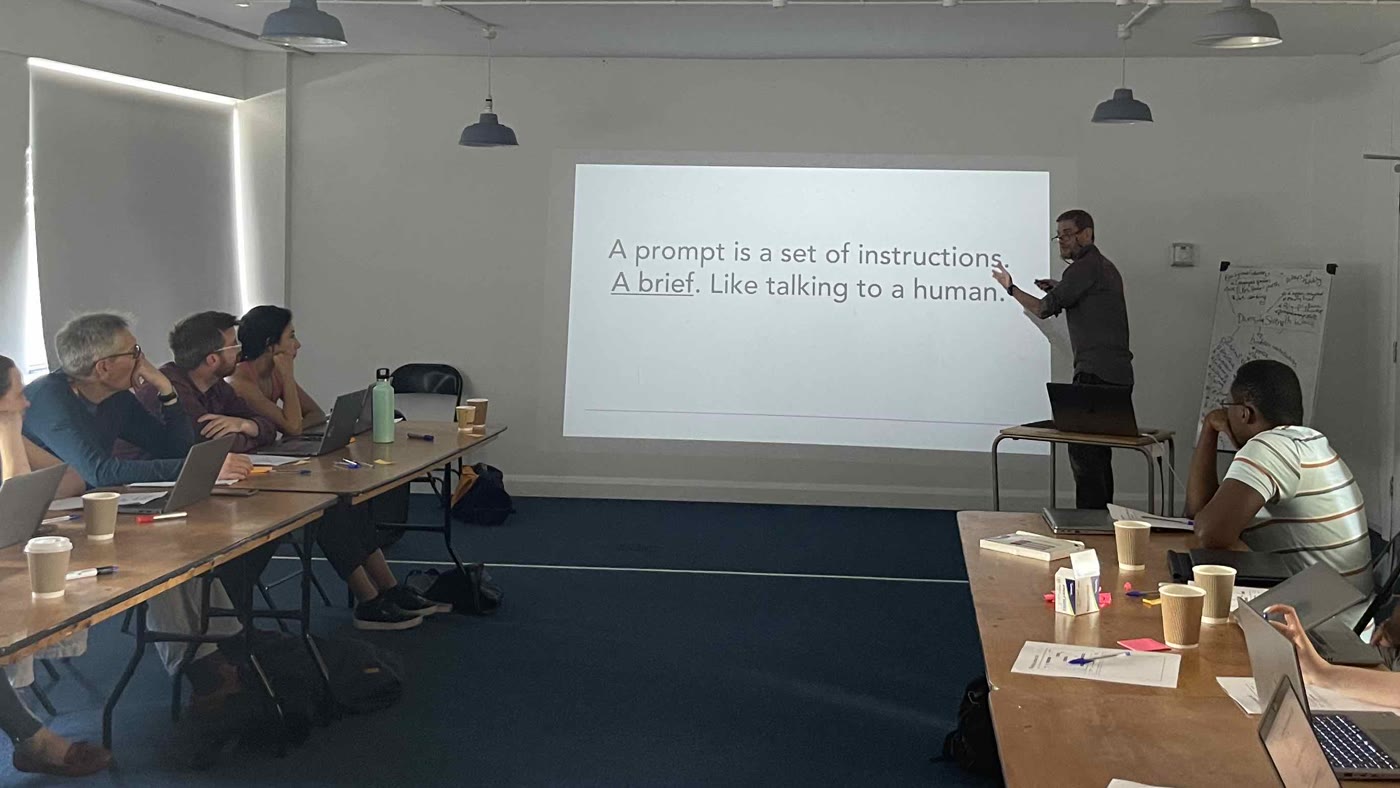
Matthew Thistle teaching a room of University of Bristol Business School staff, beside a slide that reads: A prompt is a set of instructions. A brief. Like talking to a human.
Teaching at the University of Bristol Business School, June 2025.
University of Bristol Business School, June 2025: the room listing which of their tasks are worth handing to AI.

The address at the end, aiefficiencymena.com, is my sister domain for the Middle East and North Africa.

Bristol workshop highlights

Workshop type
AI Productivity Implementation Workshop
Participants
Business School faculty and students
Key focus areas
Task identification methodology; hands-on automation exercises; practical prompt engineering.
Key outcomes
Active participant engagement; practical automation identification; framework implementation understanding.

08 · King Fahd University

King Fahd University workshop: AI productivity transformation

Challenge

KFUPM faculty members were struggling to incorporate AI tools into their teaching and research workflows. Despite having access to advanced AI platforms, many were getting inconsistent results, wasting significant time on trial and error, and lacking a systematic approach to AI implementation.

Solution

Matthew Thistle delivered a comprehensive workshop introducing the AIMED framework for AI productivity. The session focused on:

  • Task identification methodology specifically tailored to academic contexts
  • Prompt engineering techniques for research and educational content development
  • Workflow integration strategies for faculty administrative tasks
  • Introduction to the AutoGrader tool for assessment efficiency

Results

The workshop was met with exceptional enthusiasm from faculty members, who consistently praised both the content delivery and practical applicability of the AIMED framework. Participants immediately recognised the value of structured AI integration approaches and expressed strong interest in continued learning opportunities.

A workshop became a course.

KFUPM's first prompt engineering course, designed by the speaker they invited for a 2-hour session.

Feedback highlights

"Best event I have attended in 20 years! Excellent speaker — he should make a university course to be taken by students instead of COE 292"

Faculty Member

"The subject was very relevant. The session was very engaging. We need more talks from the same speaker about advanced use of LLMs."

Education Department

"It was an eye opener workshop to me. The speaker did a wonderful job. I do wish we could have had more time!"

Faculty Member

"Very good, very interesting and relevant to current developments. Thank you for the excellent presentation."

Academic Development

Long-term impact

Following the workshop's success, Matthew Thistle was appointed as an AI Productivity Consultant to KFUPM and tasked with formulating the university's first course on prompt engineering. He delivered an evolved version of this workshop to all leaders of KFUPM through the Department of Academic Development.

King Fahd University of Petroleum and Minerals, January 2025: my first AI workshop, structuring a prompt with tags so AI sticks to it.
King Fahd University of Petroleum and Minerals, January 2025: from a brief to a first draft.

Case study highlights

Workshop type
2-hour AI Productivity Mastery
Participants
35 faculty members across departments
Primary challenges
Inconsistent AI results; inefficient workflows; lack of structured approach.
Key outcomes
Improved AI confidence; successful workflow implementation; productivity gains across departments.
Follow-up initiatives
AI Productivity Consultant appointment; first prompt engineering course development; leadership workshop rollout; AutoGrader benchmarking negotiations.

09 · Claims

The denied boarding claim

Why high cognitive load tasks defeat knowledge workers

The scenario

A passenger is denied boarding on an international flight. They've paid for a ticket, extras and insurance. The total recoverable amount is between £200 and £920. This isn't a complex legal matter. It isn't intellectually difficult. Yet the passenger delayed filing for 30 days and nearly abandoned the claim entirely, losing money they were legally entitled to.

Not because they lacked intelligence. Because the task isn't 1 task. It's a chain of 15+ subtasks spanning 6+ platforms, multiple logins, file formats, legal frameworks and communication channels, all with no single interface to manage them.

Cognitive load, not complexity.

15+ subtasks across 6+ platforms. Most people abandon, not because the task is hard, but because it's diffuse.

Why people abandon workflows like this

  • Context switching cost: the task spans email, phone camera, image editor, web search, word processor, airline portal and calendar. Each platform switch carries a cognitive reset penalty.
  • No single interface: there's no dashboard or system managing this end to end. The human brain is the project manager, and it has other projects.
  • Ambiguity at every step: which law applies? Which entity to claim against? What document type to select? Each ambiguity is a micro-decision that consumes willpower.
  • Emotional friction: the event itself was stressful. Revisiting it for administrative purposes reactivates that stress.
  • No immediate reward: the money arrives weeks or months later. The effort is required now.

The 201 lesson

Of the 15+ subtasks in this workflow, current AI can fully handle roughly half: legal research, drafting formal letters, extracting data from emails, resizing documents and setting reminders. It partially handles portal navigation and form filling. It can't perform physical actions or authenticate on your behalf.

The effective operator doesn't try to do everything manually or trust AI with everything. They delegate the high cognitive load research and writing to AI, then carry out the portal submissions and physical steps themselves. That judgement, knowing which parts to delegate and which to keep, is the 201 skill most people are missing.

Case study highlights

AI capability (2026)
Full on 6 tasks, partial on 3, human-only on 3
Claim value
£200 to £920
Time delayed
30 days
Root cause
Cognitive load, not complexity
Key insight
The 201 skill is knowing which parts to delegate and which to keep.

This is the kind of workflow I map in the Diagnostic Audit.

If your office would break first, start here.

Start the admin check

I use Google Analytics to see which pages help people. It only runs if you say yes.